JUSTICE AND TRADITIONS OF SVANS
The poverty and lack of arable land prevented mountain population from having
stratification of classes. Therefore, feudal relationships were hardly visible
in Georgian highlands. In Pshavi, Khevsureti, Mtiuleti, Khevi, Tusheti and
Svaneti the population had never got used to the Serfdom and maintained their
communal life-style until the twentieth century.
In early ages, Svaneti Saeristavo (a territorial administrative unit) was an
important political-economic component of the Georgian state. The Royal Court
appointed the Chief of Svaneti. After Georgia split into smaller kingdoms and
principalities, the Svaneti Saeristavo was abolished and became influenced by
neighbouring principalities. At the beginning of XIX century, Kvemo (the lower)
Svaneti (currently Lentekhi district) fell under the patronage of the Samegrelo
Principality of Dadiani. Whereas the West part of Zemo (the upper) Svaneti
(currently Mestia district), so called Svaneti beneath Bali, was subordinated to
Dadeshkeliani's principality at the end of XVIII century. As for the East
Svaneti, (the area above Bali starting from Latali community up to the source of
the river Inguri) it maintained its independence and the status of free Svaneti
after long and hard struggles.
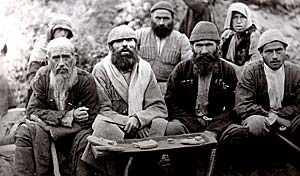
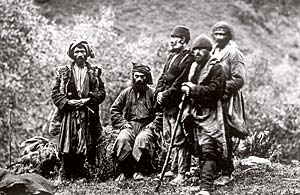
Communal lifestyle was characteristic to Georgian highlands from ancient
times. A Chief - Khevisberi, called Khutsi in Khevsureti, Dekanozi - in Tusheti
and Makhvshi - in Svaneti led the community. A Svanetian type of community
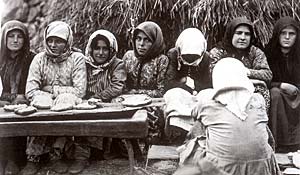
governance was very democratic: the general meeting of a community elected
Makhvshi - the community leader. The community members of both genders after
twenty years of age had the right to attend the meeting. The Makhvshi should be
a distinguished individuality known for his intelligence, reliability, fairness
and honesty. It was a person obedient to the religious rules and preacher of
Christianity, a judge in peaceful times and a leader of army in wars.
In most important cases there was held a united congress of rural communities
- Convention of Khevi, where the majority of those present attendees made the
decisions. The Convention discussed relevant domestic and international
problems, complicated issues of the neighbourhood, proposals on preparation for
the forthcoming wars and defensive strategies, issues related to the
construction of big churches, fortifications, roads, bridges and other
facilities and the contribution of each community to the mentioned public
undertakings. The Convention also discussed legal aspects and imposed
punishments.
The Convention was the supreme institution in the legal hierarchy, it was not
accountable to anybody and its decisions were final and irrevocable.
The last Convention of Khevi was called in 1875; the reason for its
convocation was a mass protest against the decision of the Russian Tsarist
government concerning introduction of increased taxes. With this regard, the
Russian governor was planning to start registration of lands and livestock. Free
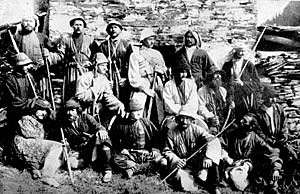
Svans publicly swore to disobey that decision of the government. Two thousand
armed farmers blocked all roads and paths. The government was scared and
compromised until people calmed down. Later, in 1876, they secretly brought a
huge army to Svaneti and on August 20 laid a siege of towers where about fifty
rebels were hiding.
The punishment operation was executed by four companies of the N161
Alexandropol infantry regiment, two teams of Kutaisi infantry militia, a guncrew
of N39 mountaineers artillery brigade, a sappers' company, troops of Guria
militia and a Becho military unit. Five Cossack posts were arranged to ensure
communication with Kutaisi. The operation was led by the General Tsitovich.
After six days of continual gunfire, the troops destroyed all eleven towers,
all stone houses, and wooden buildings, burned up cornfields and ruined down the
village of Khalde.
The government troops had only two injured and 12 dead soldiers, whilst two
settlers of Khalde died under the ruins of the towers, eight of them were
arrested, others managed to escape. The Russian troops left the ruined village
of Khalde on August 28.
The Khalde revolt was the third and the last armed protest of Georgian
mountaineers against the Russian Tsarist rule. The first one is known as the
Mtiuleti revolt, which was repressed in 1804, the second is known as Kakheti
revolt repressed in 1812. The Caucasus Vice-Roy Ratishev severely punished the
Khevsurs who took active part in Kakheti revolt in 1813. The Russian military
troops under the command of Generals Simonovich, Tikhonovski and Stal burned up
Khevsureti and repressed Khevsurs in the village of Guro.
Agricultural land in Svaneti was privately owned, as for the pastures and
meadows they were under the community ownership. Besides, there were lands and
woods owned by churches and used for their needs and religious holidays. A
community leader - Makhvshi controlled the usage of pastures, meadows and woods
by the population, he also regulated issues of land redistribution and
surveying. He settled all disputes arising in the community in presence of four
or five witnesses.
Makhvshi was very rigorous but fair in his judgments. Wrongdoers, thieves and
those, who disgraced the community were condemned and banished. "All doors were
closed for the exile. He and his family would be refused to mill their grist in
the community's mill, to enter the church and to send their live-stock with the
community's herd" (Vazha Pshavela). In case of committing a grave crime Makhvshi
used to call the Khevi (community) Convention that would make a decision on
banishing the offender from the community and burning up his house. Sometimes,
the Convention even sentenced the offenders to death.
All criminal and civil cases were discussed in a local court consisting of
judges-mediators - called "Morvals" in Svaneti.
The both litigant parties elected Morvals among their relatives or outsiders.
Morvals carefully listened to the both parties. The negotiation process was long
and often took years. When everything was clarified, the parties would go to
swear on icon. After swearing, nobody would doubt about the fairness of the
decision that was final and irrevocable. When the sentence was announced, the
judges used to dig a stone into the ground that would mean the end of the case
and conciliation of the parties.
Svans were rather dependant upon crops they harvested, because it was very
hard and sometimes even impossible to transport grain from lowland to the
mountains.
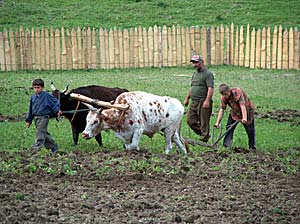
Farming is not an easy thing in mountains, because heavy showers and torrents
often wash down the green fields, or the plants are broken by hail. That is why
Svans always wish to have good weather.
Preparations for harvesting season started immediately with the New Year. At
the beginning of February Svans used to celebrate a holiday "Lamproba"
(Candlemas). A torch was made of birch sticks. All families would have three
clusters of birch sticks - one for the Holy Virgin, another for St. George and
the third for the Heavenly mercy. The Holy Virgin was believed to be the patron
saint of harvest. At the celebration eve Svans took the clusters to the cemetery
near the church and burned them there. They also baked special cookies "Lemzirs"
and had a merry time.
In winter, Svans used to build up a snow tower. They used to put a wooden
post in the centre of the tower and hung a cross on the top of it. The youth
used to divide into groups by their neighbourhoods and each group tried to fall
down the snow tower towards their own neighbourhood, which would bring them
better harvest for the new season. Getting hold of the cross was also believed
to be a good sign. Sometimes young people even fisticuffed to grasp the cross
from the top of the post. This was indeed a joyful celebration.
On the last week of the Lent the so-called "Horieshmao" started, when the
family leader would beat two iron bars onto each other, pray and scare the
goblins. Afterwards he would go out and shoot his flint-gun. The housewife would
tie black threads on the right hands of the family members, on the horns of the
live-stock and even on farming and household tools. The same day, they would dig
a thorny stick into the ground of their cornfield, and spread there sand and
white pebbles brought from the river. This was believed to be a good protection
from evil spirit and evil-wishers and could guarantee good harvest.
In drought periods, Svan women used to drop a bone into the nearest lake and
prayed for a rain. In some communities men used to bring icons of Jesus Christ
and the Holy Virgin from the churches to the river bank and sing religious
chants praying for the rain. There still exists a holiday of St. Elias when
people pray for rain to the St. Elias's icon.
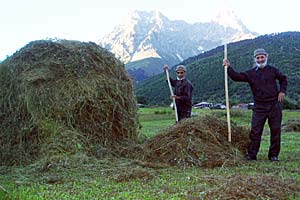
During the field works women worked side-by-side with men. Maybe for this
reason a young bride would always bring a reaping hook to her husband's family
together with her dowry.
When the weather went bad, the mountaineers had to hasten harvesting, mowing
or other works. For this, they used to call their neighbours and relatives for
help. This method of cooperation - when people helped each other without any
payment - was called Nadi.
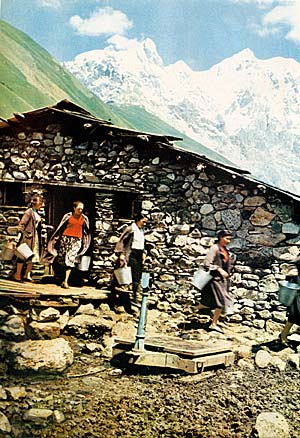
Construction of massive stone houses and towers exceeded the ability of one
family. This was another reason for cooperation between the community members, -
a so-called Mamitadi known in Svaneti as Lindi.
In order to get extra income Svans used to work in lowland villages in
winter. Due to their severe living environment, Svans were very diligent, strong
and skillful. That is why Svans were rather highly valued at the labour
market.
|





 ABOUT SVANETI