FOLLOWING THE STEPS OF ANCESTORS
Human attitude towards the mountains has been eventually changing. In antique
times and even earlier the mountains were mistified - they were beleived to be a
home place of gods, like Mount Olimpus for Greeks, Mount Sinai for Israelites,
Mount Kailas for Buddhists etc. That's why people treated them with respect and
even with fear. Svans used to say that climbing Mount Ushba was strictly
prohibitted and whoever dared to trespass this ban would be punished by God. But
the fear could not quench the curiosity of the bravest men who wished to climb
high mountains.
Natural sciences as they developed eventually also found a special interest
towards mountains. The first explorers of mountains were named alpinists. One of
the first among them was a hunter Jacques Balmat and a young French doctor
Michel Paccard from Chamonix, who were inspired by a well known scientist
Horace-Benedict de Saussure in 1785 to climb Mont Blanc. Next year Saussure
himself climbed the highest peak of Mont Blanc and also managed to carry his
scientfic equipment with him with the help of the local people. The scientist
started studying the glaciers. This fact gave the birth to the academic twins:
glaciology - the science studying glaciers and alpinism - the main instrument
for exploring mountains.
Initially, alpinism was only a way to study mountains and only later it
became a sport.
At the beginning of XIX century mountaineering in Alps became somewhat
massive activity. There appeared number of explorers and researchers who could
enjoy both: satisfaction of the scientific interests and a pleasure of reaching
the peak. Among the most popular scientists of the mentioned period are: a
Scottish scientist James Fobbs, Swiss Jean Louis Agassiz and a successful
English entrepreneur and researcher Francis Tucket. The latter spent 18 summer
seasons in Alps, climbed 160 peaks, crossed 370 ranges carrying with him
different scientific equipment - mostly handmade.
Among the first scientist - researchers paying interest to the Caucasus, and
namely Georgian mountain systems were a German geologist Herman Abiss - who in
1850-ies was the first to make an outline of the Caucasus mountains and
investigate their geologic structure; a famous geographer and traveller, the
president of the Great Britain's Royal Geographic Society Mr. Douglas William
Freshfield. - who was the first to reach the Mkinvartsveri peak and the East
peak of Elbrus in 1868, climbed Tetnuldi in 1896 and published two volumes of
his book "The Exploration ofCaucasus" the same year, in London.
The Caucasus was a subject of interest of many foreign researchers, they are:
an English researcher J. G.Cockin who was the first climber of the rough South
peak of Ushba in 1888; a Hungarian Deak (author of the book-thrilogy "Caucasus"
published in Berlin 1905-1907); an Englishman Murmer - the author of many
studies and among them of a book "My way up to Alps and Caucasus Mountains" -
published in English and later, in 1903 translated into French; another
important work to be mentioned is a two-volume capital research "The Caucasus
Highland" of the famous German mountaineer and researcher Gotfrid Merzbacher
published in 1901 and devoted to Caucasus.
A distinguished role was played by an expedition organised by a German
alpinist Adolf Schultze during his epopee of conquering Ushba. His group was the
first who managed to be so brave and full of professionalism to conquer the
North Ushba in 1903. This route is still known as the Schultze's route.
A great contribution to Caucasian studies were made by a famous Italian
mountaineer, researcher and photographer Vittorio Sella. He visited the central
part of the Caucasus three times (1889, 1890, 1896) - the most complicated
mountain chain from Mkinvartsveri to Elbrus - the hardcore of Caucasus. Vittorio
Sella climbed many peaks, he crossed the Caucasus range many times, described
and photographed the prettiest landscapes of Svaneti, Ratcha and Khevi,
historical villages, architectural monuments, current life-style, traditions,
rituals etc. He was the first documentary photographer of Caucasus and we owe
him over 400 high quality photo-negatives with very important comments and
notes.
A significant input in Caucasian studies was made by Russian scientists and
travellers, also by Georgian scientists who undertook an accurate research of
Georgian Mountain regions. They studied hypsometric and terrain features, snowy
and icy massifs, hydrology, botanics of alpine zone, mine deposits,
ethnoculture, and of course, the perspectives for the development of tourism.
In 1923 professor Giorgi Nikoladze led the first mass alpinist and
mountain-tourists' movement in the former Soviet Union.
Giorgi Nikoladze (1888-1931), a professor of Tbilisi University, one of the
famous representatives of Georgian school of mathematics, organiser of
ferrous-alloys industry in Georgia; He initiated and took an active part in
developing the Georgian technical, mathematical and sports terminologies.
Giorgi Nikoladze founded a sports club "Shevardeni", that later transformed
into a mass sports movement; Nikoladze was the founder and the Head of the
Department of Tourism and Alpinism at the Georgian Geographic Society.
Zestafoni Plant of ferrous alloys in named after G. Nikoladze; also the
highest peak in Pamir, on the Kashgar range is named after him.
In Soviet times Svaneti was a well recognized place for tourism. There were
different tourist routes laid across beautifull mountain chains and ranges and
directed to the North - towards the Russian Federation. After disintegration of
Soviets these routes became redundant due to strained political relations. The
infrastructure related to mass tourism (tourist bases, alpine camps, hotels,
shelters and etc.) ruined and disappeared. Instead, now we can observe emerging
family owned tourism businesses, mainly it is appearance of small hotels and
guest-houses offering accomodation, food and transportation in Svaneti's new
tourist routes, mainly on foot and horse riding tours to the natural beauties
and mountain paths including all security measures.
Jean Louis Agassiz (1807-1873), a Swiss scientist - naturalist, author of a
capital work on fossil fish. He initiated scientific studies of Ice Age.
Vittorio Sella (1859-1943), an Italian traveller, alpinist, professional
photographer, pioneer of using a photocamera in alpine researches. He visited
and described mountain systems of four continents, among them: Alps, Caucasus,
Sikkim, Nepal (together with Freshfield), Aliaska, Himalayas, - Karakorum
(together with the expedition of Duke of Abruzzo), Morocco and so on.
He received different awards: the order of the Italian Royal Crown and the
order of St. Ann from Russian King Nicholas II. He received a Gold Medal for the
first Italian exposition of photography (1887, Florence; Murchison Award of
Royal Geographical Society of London (1890); a Silver medal of Moscow
Geographical Society (1892); a Big Gold Medal of Torino Photo-exhibition (1893),
a Gold Medal of Salzburg International photo-exhibition (1895); Grand Prix of
French Alpine-club at World Exposition of Paris (1900) etc. In different periods
he was elected honourary member of alpine-clubs and other professional
associations in Italy, Switzerland, London, France and the United States of
America.
Due to uncontrolled wood cut and grazing in mountain regions of Georgia as
well as anthropogenic factors the upper boundary of the alpine zone forests have
lowered down to the 2000-2200 meters above sea level. Fortunately, Svaneti still
maintains its natural thermal boarder at a height of 2500 meters above sea
level.
|

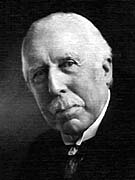
D.W. Freshfield
|
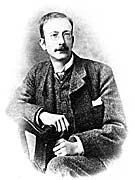
A.F. Mamer
|
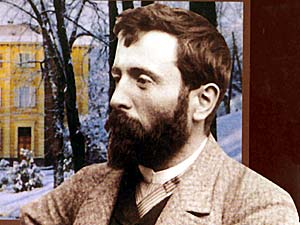
V. Sella
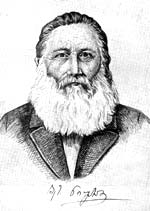
|
Besarion Nizharadze
XIX century's famous scientist and public figure, researcher of Svanetian
history, folklore and ethnography
|
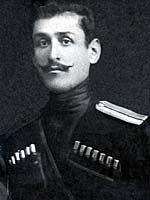 Egnate Gabliani
(1881-1937).
The Enlightener and Leader of Svaneti, Advocate of Svanetian historic
monuments, founder and the first director of Svanetian museum.
He graduated St. Petersburg University department of oriental studies.
Egnate Gabliani gave a broad coverage of Svanetian issues in newsappers
and periodicals. He is an author of several books, one of which, namely,
his study of "Free Svaneti" (1927.) consists fundamental historic
ethnographic materials. E.Gabliani was one of the initiators of
construction of Zugdidi-Mestia motor road and the Mestia airport.
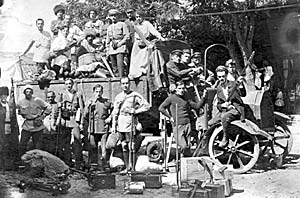
The first scientific expedition in Caucasus arranged by professor
A. Didebulidze in 1923
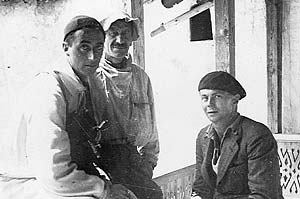
Iago Kazalikashvili and Nikolai Vavilov
more...
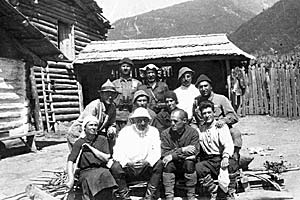
Makrine Kurdiani - "Landlady of Ushba".
more...
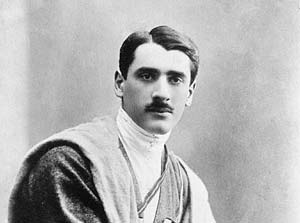
Giorgi Nikoladze (1888-1931)
more...
|





 ABOUT SVANETI