MUSEUM UNDER OPEN AIR
The period of social, economic, cultural and political renaissance in Georgia
in X-XIII centuries resulted in creation of a united, powerful Georgian feudal
state. Svaneti maintained its independent governance, still taking active part
in the country's development and defense processes. The progress of the country
also reached the Svanetian highlands. There are still existing about 70
Christian churches and many worship sites - some of them bearing signs of
paganism - rich with donations. The Latali community solely has 24 churches, the
village of Adishi - 7 churches and etc. The vast majority of the religious
monuments is built in X-XV centuries and is decorated with the wall painting -
characteristic to the Georgian feudal state. The churches of villages Ipari,
Lagurki (St. Kvirike) and Nakipari are decorated by a Royal artist Tevdore at
the edge of XI-XII centuries. The Matskhvarishi church in Latali is painted by
Michael Maghlakeli in XIII century and so on. This points out to tight links and
cooperation with the central government. A certain number of churches were built
and decorated by local masters. For example, the Ughvali Church of Saint George
was built by two brothers Anton and Michael Umpriani in XIV century, the Church
of Our Savior in the village Laghami was built by Shalva Kirkishiani in XV
century, the Lenjeri Church of Archangel in the village of Mukheri was built by
Iveldiani in XV-XVI cc. etc.
According to the ancient traditions believers in Georgian highland used to
donate valuable gifts to churches. This tradition made Svanetian churches rich
of gold and silver vessels and jewelry, hunting and fighting tools and arms,
crosses and icons, horns and antlers of wild animals, coins, manuscripts and
other valuable old things. The majority of those gifts are produced locally,
others are imported from abroad. A deep respect of the local people towards the
community and religion kept these treasures untouched until XX century. The
government protects today the treasure, which is kept in churches. The major
part of the sacred things you can see in the Svaneti historical-ethnographic
museum of the town of Mestia.
Svaneti is rich with architectural monuments of the mid feudal epoch, namely
with residential compounds, towers, farming buildings, originally curved and cut
wood furniture and other household commodities.
Georgia was always an arena for the clash of cross-political interests of
neighbouring countries; manifested in endless wars for seizing Georgian
territories and influencing the country's policy. The waves of the wars were
reaching Svaneti and that is why the houses of Svans look like citadels.
One of the main components of a Svan's house is a tower. It is a square stone
pyramid with dimensions of the base 5 to 5 metres, which usually has four or
five floors and is 25 meters high. For security reasons the last floor has small
windows - wider from inside than outside. The tower's angle is directed towards
the slope. Its massive hemi-spheric basement and spatial orientation ensure the
sustainability of the building and resistance to the natural disasters
(avalanches, landslides, etc)
One can still find a whole system of watchtowers in the mountains. In case of
forthcoming threat, the guards would burn straw on a top of the first tower,
after seeing a smoke; the guards of every next tower would do the same - thus
giving an alarm signal to the population of the canyon. In case of a poor vision
in the foggy weather, the guards signaled by shooting their guns.
Besides the watchtowers there were several fortification posts that kept
control over the Caucasus ranges. There still exist ruins of such constructions,
like for example, two gates in the gorge of the river Tviberi.
A residential house of a Svan (Machubi) is a big two-storeyed building. The
ground floor was used for living and keeping livestock, the first floor was used
for storing hey. The house was heated by a hearth in the centre of a big room,
where they also cooked their food. As a rule, the house was attached to a tower.
Sometimes Svan's families consisted of up to thirty or even a hundred members.
We can still find such huge residential compounds in Mulakhi community. For
example, a three metres tall fence surrounds the residential area of the Kaldani
clan. There are two towers (one still in a good condition), a small church with
unique crosses, icons and sanctuaries inside the fence. Judging by the ruins we
can assume that there have been three houses; one with three floors and the
other two with two floors. There also was a threshing-floor, and a dungeon and
secret tunnels connecting the residential area with the outside world. A very
similar living infrastructure can be found in the town of Mestia and in the
village of Latali.
The history and culture of Svaneti is penetrated with folk music.
Commensurate to the severe nature and hard life-style the Svans' singing is
somewhat rigorous and powerful. The songs are mainly dedicated to the national
heroes, the fights against the conquerors, the religious holidays, the famous
kings (e.g. Queen Tamar), the goddess of Hunting Dali etc. Many songs have been
created even before the Christian times and therefore include heathen elements
(e.g. the song "Lile" - dedicated to the goddess of the Sun "Kaltidi" and etc.).
When you listen to these songs in Svaneti surrounded by snowy mountains and
"captured" by tall towers, you certainly feel a wonderful metamorphosis and
start to travel through the world of mid ages losing the sense of real time.
|

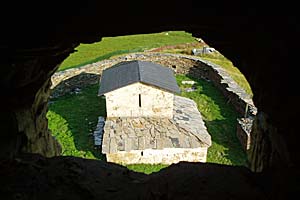
Saint Mary's Church. Ushguli
(A.Jobava's photo)
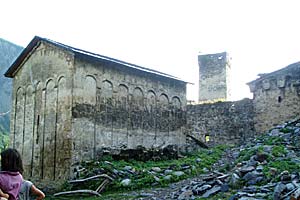
The Kaldani family church. Mulakhi
(V.Naveriani;s photo)
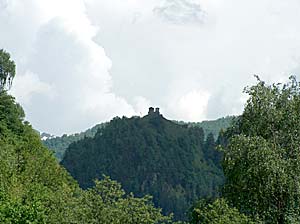
Saint Kvirike's Church. Kala
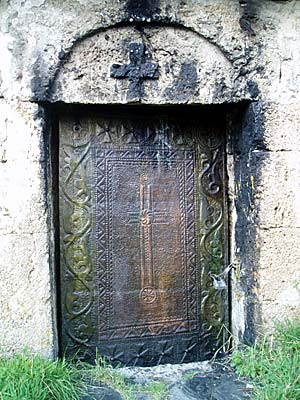
The Church door
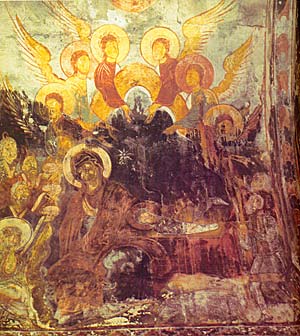
Christmas. Wall painting by Tevdore,
Iprari Church 1096
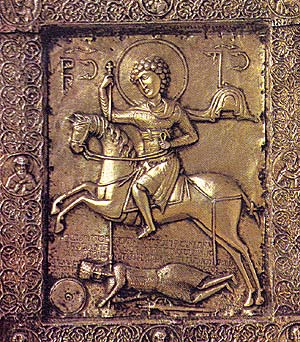
Saint George. Chiseled icon.
Master Asani. Nakipari XI cent.
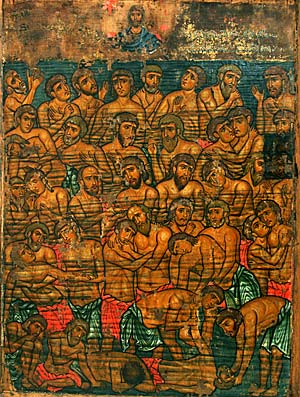
Hand painted icon. Forty martyrs.
Svaneti historical
ethnographic museum. Mestia
(V.Naveriani's photo)
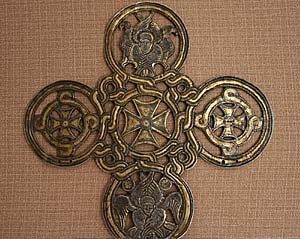
Cross. Mestia, Svaneti historical
ethnographic museum
(V.Naveriani's photo)
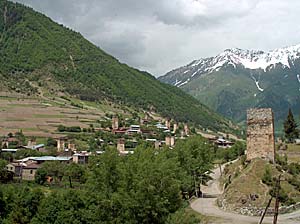
Mestia
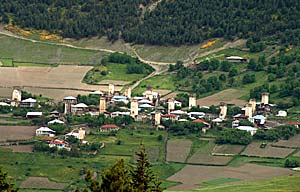
Mulakhi
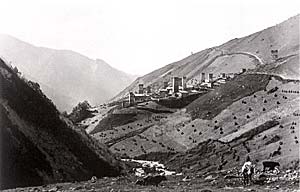
Adishi. In 1890 Vittorio Sella
recorded in Adishi 14 towers.
Presently there are only about five
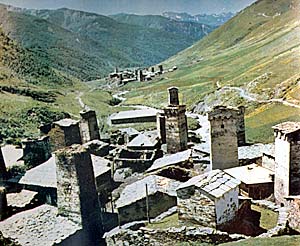
Ushguli.
(G.Tikanadze's photo)
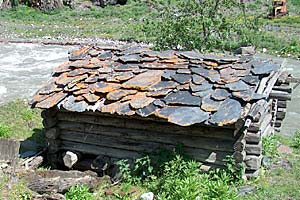
Watermill. Kala
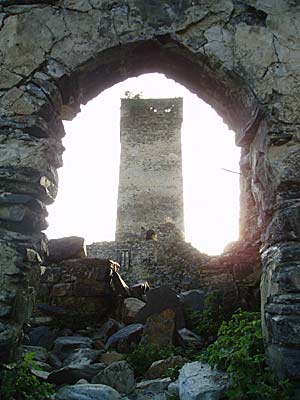
Tower
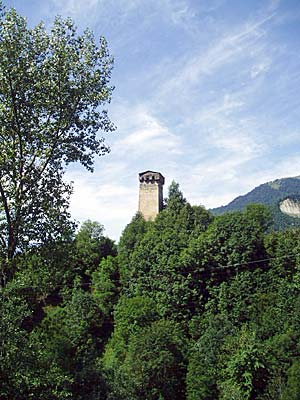
Tower. Mestia
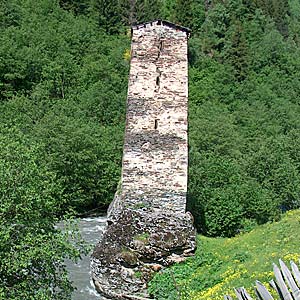
A Tower built on erratic stone. Kala
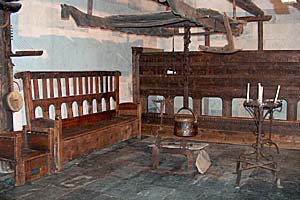
Svanetian home, (Machubi) Sajalabo room.
(Svaneti historical ethnographic museum. Mestia)
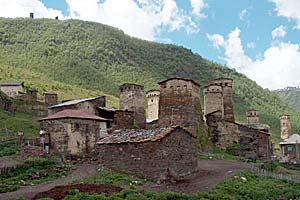
Towers and Machubis in Chvibiani.
On the hill, a watch-signal tower.
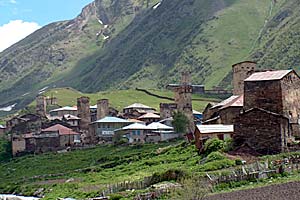
Old style and modern houses
in the village of Zhibiani.
|





 ABOUT SVANETI